| A Constitution to Save the Republic Constitutions have been used throughout much of Western civilization to establish the basic rules governing the governance of a community or political system. One of the key issues in a political system is the distribution of power, i.e., who makes the decisions and administers the government. In ancient times, major concerns were trying to achieve stability and continuity of the political system, given the fear of change, and the worldview that things should remain the same. Decision-making power was separated into three forms of power distribution: kingship, rule of the one, aristocracy, in the hands of a select few elites, or democracy, the rule of the many. Although the goal was to sustain stability, in fact, that did not happen, with each form of government not lasting long in its given form. For example, a kingship would be established, but shift into tyrannical rule, an aristocracy would rise to take over, or a democracy would be established but eventually devolve into mob rule, where a tyrant would rise and replace the democracy. Around the period of the fifth century BCE, there emerged two political structures that were able to achieve a fairly stable system: the Greek city-state of Sparta and the Roman Republic (the predecessor to the Roman Empire). In both systems, they established a mixed constitution which combined all three forms, allowing representation for a kind, an elite few, and a democracy. This mixed system proved to be the most viable way of achieving stability and continuity, as evidenced by both these systems lasting almost five hundred years before both descended into empires. For the subsequent significant development, we turn to the 17th century in England (later Britain), where they reminded themselves that kingship was not the ideal form of governance. Then, with the American Constitution, our founders followed the model of a mixed constitution while recognizing the need for several degrees of refinement. As the ink was drying on our Constitution, the modern constitutional era began in France with the French Revolution, followed by European and South American countries making efforts during the early 19th century. Where are we today? The problem with modern times, perhaps soon to include the United States, is that few nations have been successful in establishing and retaining popular sovereignty rule. Marxism, embracing Utopian ideals, and other approaches have each failed to achieve a true democracy, devolving into dictatorships. [For more, see Ken's full commentary.] |
| |
|
 | Kenneth Mitchell
First Unitarian, Baltimore |
| | |
|
| | | Annual Faith in Democracy Series
Hosted by FAN, co-sponsored by UUSJ Tuesday, January 6
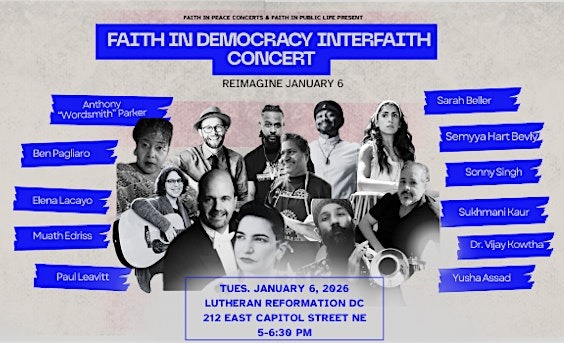
Various Times, see details below Our friends at Franciscan Action Network (FAN) are hosting the next event in the annual ‘Faith in Democracy’ series. This year, they have organized both an Interfaith Concert and a Policy Panel around themes of New Vision and Facing Challenges. Interfaith Concert: A New Vision of January 6
5:00 p.m. ET • 4:00 p.m. CT • 3:00 p.m. MT • 2:00 p.m. PT FREE Eventbrite Tickets
Livestream via YouTube Elena Lacayo will sing "Let's Stand Together" about solidarity. She will perform another song on behalf of vulnerable immigrants, a common theme across faith traditions, perhaps "Pueblo Migrante" or "Amor Migrante". The concert will feature several other artists. |
|
|
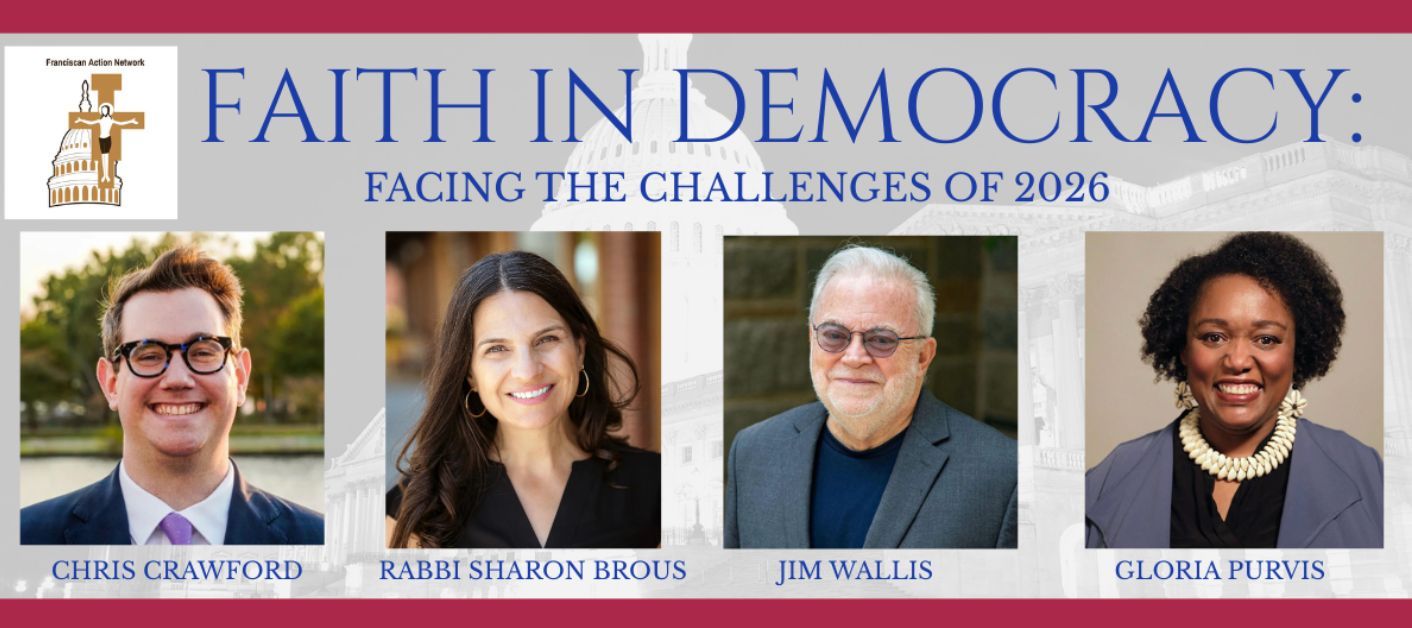
| Policy Panel: Facing the Challenges of 2026
7:00 p.m. ET • 6:00 p.m. CT • 5:00 p.m. MT • 4:00 p.m. PT
RSVP (Online) Please join a digital panel discussion exploring the connection between faith and democracy, the current challenges to U.S. democracy, and how people of faith and faith communities can work together to strengthen our democracy. This panel will be moderated by Chris Crawford, the Senior Director of Civic Strategies at Interfaith America, and featuring Jim Wallis, the founding Director of the Georgetown University Center on Faith and Justice; with Gloria Purvis, senior fellow for Georgetown University's Initiative on Catholic Social Thought and Public Life; and Sharon Brous, senior and founding rabbi of IKAR, a Jewish community based in Los Angeles. |
|
|
| | Interfaith Nonviolent Resistance 2.0 Co-sponsored by UUSJ, co-led by Interfaith Alliance, the Center on Faith and Justice, Sojourners, Faith in Action, Political Research Associates, and the Horizons Project Monday, January 12
7:00 p.m. ET • 6:00 p.m. CT • 5:00 p.m. MT • 4:00 p.m. PT
RSVP (Online) Building on the foundations laid in October at the online Interfaith Nonviolent Civil Resistance 101 training, this 201-level session will shift from frameworks to real organizing and tactics. The focus will be on-the-ground discernment by faith leaders (clergy and lay) and on how such leaders are taking action to resist authoritarianism and defend democracy in their communities. If you joined the October session, this is a critical follow-up before the corresponding local-area train-the-trainer sessions begin and are announced. For more on the October 101 session, see a UUSJ post about related next steps. To prepare for the deep work of spiritually disciplined engagement, organizers suggest you review and consider the following three key documents: - The Theological Declaration of Barmen (1933)
- Alabama Clergymen’s Letter to Dr Martin Luther King, Jr & Letter From Birmingham City Jail - Dr. Martin Luther King, Jr. April 16, 1963
- The South Africa Kairos Document 1985
|
|
|
| No-frills Action Hour Tuesday, January 13
7:30 p.m. ET • 6:30 p.m. CT • 5:30 p.m. MT • 4:30 p.m. PT
RSVP (virtual) Topic: Oppose the “Constitutional Concealed Carry Reciprocity Act of 2025”
This National Legislation would override all state regulatory laws restricting concealed carry, requiring states to allow individuals to carry concealed firearms in any state if they are eligible to carry concealed guns in their home state. This bill encroaches on states' rights to enforce their own public safety standards, jeopardizing public safety.
Our teams are relaunching an ongoing series of action hours. Participation will enable you to defend our democracy and champion a positive, inclusive vision for our republic. Over time, you will be invited to engage in various ways and on numerous issues. |
|
|
|
|
| | | Disparate Impact Standards Under Assault In December, amid the maneuvering over healthcare legislation, the DOJ Rolls Back Anti-Discrimination Rules (Politico). This followed President Trump's April executive order directing agencies to eliminate disparate-impact liability wherever possible. This further development concerns us. Much economic justice work and analysis pivots on the idea that “disparate impact” indeed occurs. Such effects are especially evident when examining health policy. They are often cited when demonstrating racial injustice, particularly when linked to civil rights infringements. It’s important enough that Congress has a related explainer: What Is Disparate-Impact Discrimination? |
|
|
| A More Perfect Union Means More Progressive Taxes We believe the U.S. needs a tax code that is more progressive and raises more revenue than the current one. That is an a priori step in making our economy more people-centered, rather than focused on corporations and profits. A meaningful way to achieve this is to reform the taxation of business profits. The Institute on Taxation and Economic Policy (ITEP) just published a new brief about why we need to reform our corporate income tax to raise more revenue, 10 Reasons Why the U.S. Should Reform Its Corporate Income Tax. Here are two other items by our friends at ITEP: |
| |
|
| Economic and Tax Clippings |
|
|
|
|
| Defending Our Democracy
Fred Van Deusen, Democracy Action Team Convener ([email protected]) |
| | Cultivating Spiritual Discipline We’ve been asking our volunteers to share messages of hope and commitment that inspire action or cultivate spiritual discipline. With that in mind, we share: |
| |
|
| Attention Democracy Team Leaders On Wednesday, January 14, at 7:00 pm ET, UUSJ is bringing together individuals who are leading democracy teams in their congregations. If your congregation has a social justice team focused on building a democracy movement, promoting voting and other rights, and resisting authoritarianism. You are the leader or one of the leaders. Please join us. To help us prepare, we ask team leaders to complete this short survey, by January 6th at the latest - sooner if you can. Completing the survey is a prerequisite for participation. We will send respondents the Zoom information and final meeting agenda prior to the meeting. We also encourage you to register, attend, and help spread the word about the January 12 training session, “Answering the Call: Interfaith Nonviolent Civil Resistance 201,” which will be held on Monday, January 12th, 7-9 pm ET. At the meeting on the 14th, we’ll spend some time getting acquainted, debrief on the 201 training session, and review the survey results. |
|
|
| |
|
| Environmental and Climate Justice
To connect with UUSJ about our activities ([email protected]) |
| | | Looking Back to Know Where We are Going With the deregulation blitz the new administration has undertaken in its first year, advocates and activists are revisiting a key concept: environmental racism. See the explainer Environmental Racism: A Global Overview, by Earth Org. Coined in roughly 1982 during a local fight against a newly approved landfill in Warren County, North Carolina, one of the protesters, Benjamin Chavis, is credited with articulating the idea: “racial discrimination in environmental policy-making.” His words conveyed a policy insight and truism that few were willing to speak publicly. Since then, both skeptics and supporters have explored the implications: - Where we live, learn and play: Environmental racism and early childhood development in review, Early Childhood Research Quarterly, 2024
- Racial Disparities in Urban City Planning: “Environmental Racism”, Brown Undergraduate Journal of Public Health, 2024
- What Is Environmental Racism, NDRC, 2023
- Confronting Environmental Racism, NIH, 2021
- Environmental Racism: A Skeptic’s Review, 1994
|
|
|
| |
|
| Immigration Justice
Steve Eckstrand & Terry Grogan, Immigration Action Team Conveners ([email protected]) |
| | Rhetoric Suggests, New Year Will Be Very Difficult For Immigrants We start the new year highlighting the Interfaith Immigration Coalition (IIC) statement Faith Voices Condemn Violent DC Shooting, Reject Collective Blame of Refugees, and asking you to take action with UUSJ: See our earlier, related statement, "We Condemn Recent Rhetoric Targeting Migrants." For an excellent account of the specific actions the administration took, see the American Immigration Council (AIC) post: Trump Administration Responds to Tragedy By Putting Hundreds of Thousands of Legal Immigrants’ Lives On Hold. Also, Trump Is “Basically Shutting Down the Legal Immigration System”, Mother Jones. For a sense of the harm to Afghan women, see, How the Trump Administration Used a National Guard Tragedy to Accelerate Its Anti-Immigrant Agenda, Ms. Magazine. For older but related analysis, For Victims of Gender-Based Violence, Getting Asylum Just Got Harder. |
| |
|
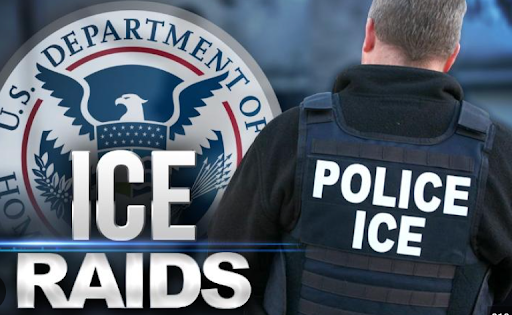
| What 2025 Has Wrought for Immigrants and Their Allies More than eleven months have passed since Donald Trump’s inauguration. During that time, the Department of Homeland Security (DHS) has deported more than 500,000 immigrants (DHS-Oct27)(DHS-Dec10) and is holding more than 60,000 immigrants, including families and children, in detention centers around the country (CBS)(MPI). The administration has long claimed its policies target “the worst of the worst” criminals, but community reporting, anecdotal evidence, accumulating data, general news (NPR) and advocate analysis (DWN)(NILC)(AIC) suggest otherwise. For example, a recent Washington Post article (via MSN) used data to trace an important shift in ICE tactics: They have moved from a posture of arresting immigrants already held in local jails (i.e., deporting people when they are detained) to active search and apprehension in communities (i.e., intentional surveillance and hunting for people). An analysis of arrests between June and October of 2025 showed more than 60 percent of people detained in “at-large arrests” did not have criminal convictions or pending charges (TruthDig). Despite DHS statements, reports have suggested, these activities include restraining, questioning, and in some cases holding, U.S. Citizens (WaPo)(AIC)(ProPublica)(NPR). In related news, The Guardian reports that the Trump administration has launched a $100 million media blitz to hire thousands of additional deportation officers and is seeking contractors to renovate industrial warehouses to hold more than 80,000 additional immigrant detainees awaiting deportation. Also see WaPo. For a look forward see, From Travel Bans To Green Cards: How US Immigration Could Change In 2026, Newsweek. In 2026, our volunteers worry most of the immigrants detained or deported will likely be people with no criminal convictions or pending charges. |
|
|
| When immigrant neighbors “Go Missing” Our volunteers occasionally get questions about resources and materials to help when people get disappeared into our U.S. immigration enforcement system. Most of the queries we receive are from allies getting prepared or being pro-active, rather than reacting to tragedy. The following toolkit, by Freedom for Immigrants “contains a broad overview of where and when people go missing within the system and guidelines on how to locate them. This is a resource intended for advocates, friends and family members of people impacted by the U.S. immigration system and does not account for attorney privileges. Please be sure to consult with legal counsel if you’re able to.” UUSJ does not provide legal services. |
|
|
|
|
| UUSJ is a tax-exempt 501(c)(3) nonprofit organization.
Contributions are tax-deductible as allowed by law. |
| |
|
| |
|
|