| Knowledge Management as Justice Work: A UU Reflection As I reflect upon UUSJ’s conversation with Rev. Dr. Liz Theoharis this past May (please share your own), I’ve been sitting with where my own activism and advocacy belong in the larger landscape of what must be done for economic justice. Her insistence that poverty is a policy choice — and that we are called to build systems rooted in dignity — continues to echo. And alongside her message, the interfaith Covenant for Our Future has stayed with me. Its bold call to repeal HR 1 after the midterms reminds us that democracy, economic justice, and moral courage are intertwined. Faith communities are not just observers of this moment; we are participants in shaping what comes next. This is where my two worlds meet: as a knowledge management practitioner and a social justice advocate. These fields keep crossing paths in my mind because they both ask the same question: Who thrives — and why? Some further thoughts about this. [Read More] |
| |
|
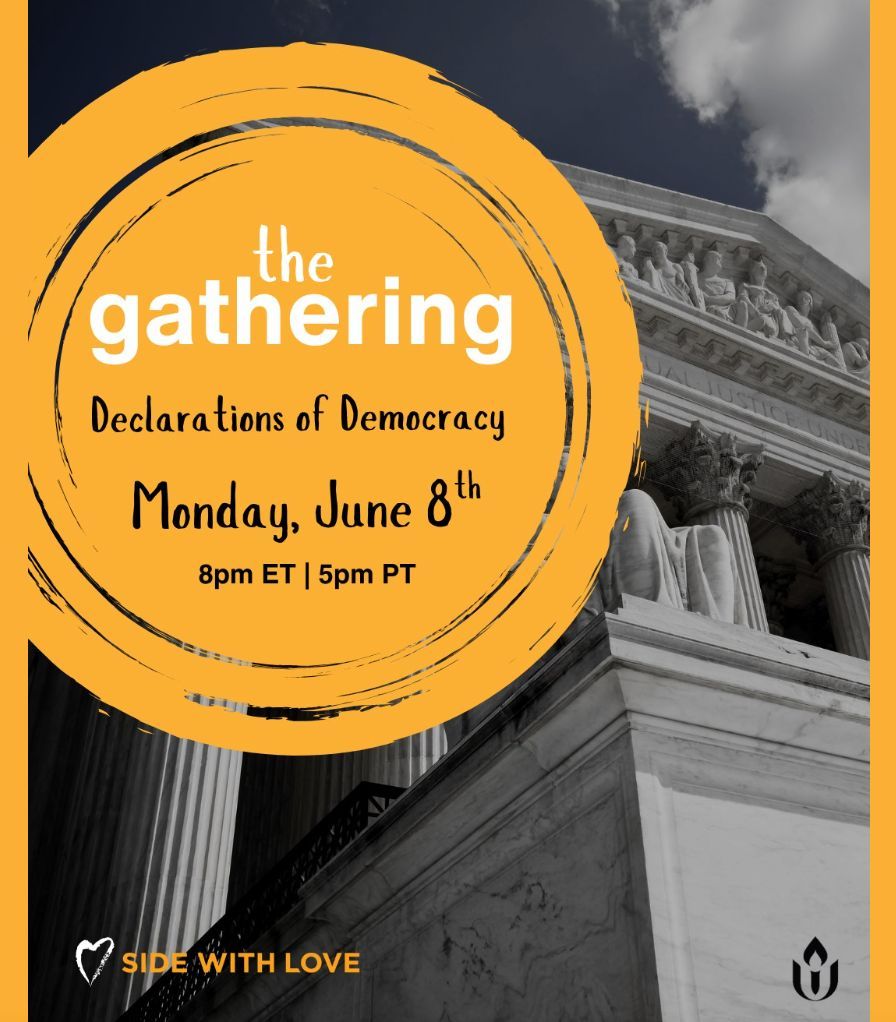
| | | The Gathering - Declarations of Democracy Monday, June 8, 2026
8:00 p.m. ET • 7:00 p.m. CT • 6:00 p.m. MT • 5:00 p.m. PT • 4:00 p.m. AT • 2:00 p.m. HT
RSVP (Online) This month, the Gathering will engage with the 250th anniversary of the United States and the prophetic call this moment places before us as people of faith. |
|
|
| The High Stakes of the Senate Farm Bill: SNAP, State Costs, Food Systems, and Community Consequences Tuesday, June 9
1:00 p.m. ET • noon CT • 11:00 a.m. MT • 10:00 a.m. PT • 9:00 a.m. AT • 7:00 a.m. HT
RSVP (Online) As the Senate shapes its Farm Bill proposal, its impact on states, communities, and families is significant. Join our friends at the Coalition on Human Needs and the Food Research and Action Center for a one-hour webinar to examine how emerging proposals could affect SNAP administration, state budgets, food access, local economies, and millions of households. With Senate discussions progressing rapidly, this is a crucial opportunity to highlight practical realities, on-the-ground impacts, and the perspectives of those facing these challenges daily. Take Action: Farm Bill 2026, the Senate must side with regular Americans |
|
|
| Solidarity Summit Interest Meeting (Learn More) Tuesday, June 9
7:00 p.m. ET • 6:00 p.m. CT • 5:00 p.m. MT • 4:00 p.m. PT • 3:00 p.m. AT • 1:00 p.m. HT
RSVP (Online) Join UU the Vote to learn about the Solidarity Summits. These summit gatherings will bring together Unitarian Universalists, people of faith across traditions, lay leaders, organizers, advocates, and community partners to strengthen regional networks, deepen relationships, and practice the kind of solidarity this moment demands. Join this session to learn more about how to participate in one of the regional summits in Pennsylvania (8/28), Tennessee (9/18), or Texas (10/2) – and learn how your congregation can host a regional solidarity summit, too! |
|
|
| Solidarity Sessions, by UUSI First and Third Fridays, June
2:00 pm ET • 1:00 pm CT • 12:00 pm MT • 11:00 am PT • 10:00 a.m. AT • 8:00 a.m. HT
RSVP (Online) June 5
RSVP (Online) June 19 (During GA) Solidarity Sessions are an opportunity for folks working for immigrant justice to connect with one another and learn about the most recent changes in immigration laws and policies that affect the types of immigration relief available and who is eligible for it. - First Fridays (e.g., June 5) – our "connections session" – includes top-level updates and time for fellowship in the work and for shared learning.
- Third Fridays (e.g., June 19) – our "updates session" – will be deeper dives into administrative activities and the impact of any changes on folks seeking immigration relief. (Ex: Naturalization, DACA, asylum, TPS, victims' services, etc.)
|
|
|
| No Frills Action Hour Wednesday, June 17
7:30 p.m. ET • 6:30 p.m. CT • 5:30 p.m. MT • 4:30 p.m. PT • 3:30 p.m. AT • 1:30 p.m. HT
RSVP (Online) Join our next UUSJ action hour. Topics and issues will be determined closer to the date. |
|
|
| Democracy Leaders Coalition Wednesday, June 24
7:00 p.m. ET • 6:00 p.m. CT • 5:00 p.m. MT • 4:00 p.m. PT • 3:00 p.m. AT • 1:00 p.m. HT
RSVP (Online) If you or someone in your congregation leads a democracy team and wants to connect with similar individuals to discuss dynamics, learn, and expand your local outreach and impact, consider applying to the coalition. Sessions are on the fourth Wednesday of each month. |
|
|
|
|
| | | Farm Bill 2026: The Senate Must Side With Regular Americans Tell the Senate to reject the harmful House Farm Bill proposal and work toward solutions that truly invest in resilient agriculture, healthy communities, and a thriving future for Americans. Congress should be advancing our nation’s sustainability posture — investing in rural communities, protecting families from harmful chemicals, and assisting farmers and ranchers who want to move away from monocrops and embrace diverse crops. It should incentivize sustainable land use and natural production methods, and it must address hunger. Of paramount importance, encourage your Senators to protect our families' interests by overturning and opposing further cuts to SNAP and other essential hunger programs. |
|
|
| Tell Congress: Stop Big Oil Immunity Our friends in the People Versus Fossil Fuels Coalition at Climate Hawks Vote are asking us to take action. Major fossil fuel companies and their allies in Congress have introduced legislation—the "Stop Climate Shakedowns Act" (H.R. 8330 / S. 4340)—to grant the industry sweeping legal immunity from climate accountability lawsuits. The Act would: - Dismiss all pending climate lawsuits against fossil fuel companies.
- Permanently shield the industry from future federal and state liability.
- Overturn state and local "polluter pays" and climate superfund laws.
|
|
|
|
|
| | | UU State Action Network of Illinois joins UUSJ We proudly welcome the UU Advocacy Network of Illinois (UUANI) into the UUSJ family —our first UU State Action Network. UUANI builds power among UU congregations in Illinois to accountably advocate with those who have been historically marginalized. UUANI covenants to listen with respect, and to hold themselves accountable to each other, their deepest selves, their UU principles, the earth, and those on the margins of society. Review our member/partner details, if you are primed for transformative action and want to learn how your Congregation, Church, or Fellowship can deepen your federal engagement. |
|
|
| GA 2026 The Unitarian Universalist Association (UUA) General Assembly (GA) is the annual meeting of our faith tradition, where participants gather to worship, witness, learn, connect, and make policy decisions for the Association through a democratic process. While anyone can attend, congregations must certify annually to have voting delegates. In 2026, the 65th UUA GA aims to create a virtual “everywhere GA” with both online and distributed in-person options, allowing Unitarian Universalists to participate in various ways. This new format will reduce travel costs and environmental impacts, offer optional in-person connections, streamline production costs, and provide a more flexible schedule for participants. Find the Schedule here, and GA registration information here, or more about the in-person participation options here. |
|
|
|
|
| June UUSJ Board Meeting Our Trustees will meet on Friday, June 26, 2026; for more information, email [email protected] |
|
|
| Defending Our Democracy
Fred Van Deusen, Democracy Action Team Convener ([email protected]) |
| | Next Generation Poll Workers The League of Women Voters (LWV) and the National Education Association (NEA) have developed a new partnership to strengthen our democracy by recruiting a diverse new generation of poll workers for upcoming federal, state, and local elections. Poll worker shortages can lead to closed polling locations and long wait times. The LWV and NEA partnership addresses that challenge by engaging educators, students, and civic-minded community members to serve as the "power" behind the polls. Learn how more here. |
|
|
| Checks and Balances Needed The President’s attempt to create a $1.8 billion slush fund for his political and ideological allies is coming under bipartisan attack. The fund proposal has stalled the Senate’s Reconciliation 2.0 efforts and seems to have kicked off additional responses: Yet, the current Supreme Court majority appears determined to extend presidential authority beyond the framers' intentions or the public's wishes. Their recent decisions undermine the core of our democracy by risking the concentration of power in one person, reducing accountability, and undermining the rule of law. See Brennan Center’s “It Ends in Monarchy.” As the Court allows for more executive power, the current President's actions, seen by many as self-serving and unlawful, further endanger the checks and balances vital to our democracy. It seems clear that the Roberts Court is embracing the Unitary Executive Theory, which argues that the President has unchecked control over the executive branch and asserts that, because the President enforces laws, they should be free to dismiss officials. |
|
|
| The Wheels of Corporate Lobbying Open Secrets reports that Uber poured millions into political spending to back ‘No Tax on Tips’. In 2025, Uber significantly raised its political spending to intensify lobbying efforts on President Donald Trump's "No Tax on Tips" initiative, aiming to secure tax breaks. Besides making substantial contributions to Trump's inaugural committee, Uber boosted its lobbying expenses by 25% and engaged a firm closely connected to the White House. The company's federal lobbying expenditures increased from $2.7 million in 2024 to $3.4 million in 2025, primarily due to intensified lobbying on tax matters and ongoing efforts on transportation, labor, and workplace issues. Uber referenced "No Tax on Tips" six times in its 2025 lobbying disclosure, up from a single mention in 2024. |
|
|
|
|
| Immigration Justice
Steve Eckstrand, Immigration Action Team Convener ([email protected]) |
| | Poor Treatment of Afghan Allies A newly released official report to Congress, “An Update to the Status of the Afghan Special Immigrant Visa (SIV) Program,” being circulated among advocates by AfghanEvac, confirms that while the Afghan SIV program technically still exists, the United States has not issued a single Afghan SIV in 2026 to applicants traveling on Afghan passports. - More than 23,000 approved applicants remain in processing,
- Nearly 6,000 authorized visas remain available,
- And no new Chief of Mission (COM) will be created.
“While COM processing, visa interviews, and visa adjudication continue for Afghan SIV applicants, no Afghan SIVs have been issued to applicants applying with Afghan passports to date in CY 2026.” The SIV program is effectively frozen: refugee pathways have been banned, family reunifications stopped, and humanitarian protections have been destroyed. At the same time, applicants continue being scheduled for interviews even though the Government knows those visas will be denied under executive actions. The government is continuing to move people through the process without meaningfully warning them that the outcome has already been decided. Nothing about this approach has happened in good faith. |
|
|
| No More Funding for ICE and CBP Just before Memorial Day weekend, Senate Republicans postponed their plans to bring a $70 billion, filibuster-proof reconciliation bill to the floor for a vote. This bill would fund Immigration and Customs Enforcement (ICE) and Customs and Border Protection (CBP) for three years but would include no operational guidelines nor any accountability measures to prevent the types of enforcement actions that we witnessed in Minneapolis. UUSJ is among many faith-based and human rights organizations opposing this reconciliation bill, and our advocacy is having an effect. But the struggle isn’t over. While the Senate pushed back on the bill (TPC), the impetus was about adding guardrails to a proposed $1.8 billion “anti-weaponization” fund that could compensate people who say they were unfairly targeted by the Justice Department, TPC, not the immoral proposition of billions more for ICE and CBP Congress will come back in early June and again try to pass this $70 billion reconciliation bill. We must continue to contact our Senators and Representatives to tell them to oppose the massive reconciliation bill and instead fund ICE and CBP through regular annual appropriations bills that include common sense guardrails and accountability measures. Use this guide to help with your messaging. |
|
|
| Articles Shared by the team - If you thought Title 42 was being applied only to undocumented immigrants, think again. Trump Administration to Send Americans Exposed to Ebola to Kenya, NYT
- On April 30, the Illinois Accountability Commission released its report on the actions taken by federal immigration agents during Operation Midway Blitz. The report documents how federal officers used unwarranted and unlawful force, denied due process, and terrorized Chicago residents throughout the operation.
- The Department of Homeland Security published a proposed increase in the per person deportation fine in the Federal Register on May 20. The proposed increase from $5,130 to $18,000 is intended to recover the full estimated cost of tracking down, arresting, detaining, and deporting a single person.
- The administration is weakening the last line of oversight for immigration detention: surprise visits by lawmakers. Previously, it had devastated the Department of Homeland Security’s inspector general and civil rights divisions and closed the Office of Immigration Detention Ombudsman. Now, ICE will only facilitate meetings with detainees during congressional visits if lawmakers request them by name and provide “valid proof of the alien’s consent to the meeting” at least two days in advance.
- A recent report describes how the Department of Homeland Security is paying well above market value to purchase warehouses for immigrant detention.
- The American Immigration Council just released a new report called “Restoring Credibility and Humanity” that provides specific policy recommendations for reforming our immigration system, focusing on four key pillars: compliance, safety, proportionality, and accountability.
|
|
|
|
|
| | | Hot On the Hill The “Senate GOP is considering delaying a cost-share SNAP requirement passed in their megabill last year - in order to garner enough support to pass a farm bill Some [Republicans] privately support delaying it, as their states will be hit by the SNAP overhaul,” reports Grace Yarrow, Politico, via X. HR.1 made major cuts and an overhaul to the SNAP program, for more see: |
|
|
| Playing Both Sides? The Department of Justice (DOJ) has expanded a settlement of President Trump's lawsuit over the leak of his tax returns (Politico). It now includes a promise that the IRS won't pursue claims against Trump, his family, or companies for unpaid taxes. President Trump is both the plaintiff and the party to which the DOJ ultimately reports. The settlement, which includes a $1.8 billion fund for victims of alleged law-enforcement weaponization, initially didn't address Trump's tax-return disputes. The IRS has now agreed to drop all pending probes into Trump's taxes, following the lawsuit over the tax return leak. |
|
|
| Pentagon Budget Impedes Social Spending As budget matters heat up, we remind our supporters that the Coalition on Human Needs, of which UUSJ is a part, sent a letter in April from 289 organizations to every House and Senate office titled “Nearly 300 Organizations Urge Congress to Reject $1.5 Trillion Pentagon Budget.” Three (3) UU organizations and two (2) Congregations joined the letter. We are not alone in our concerns see: The U.S. public is angry about economic conditions, and the middle class is losing ground, Equitable Growth. Taxes are essential for maintaining a modern democratic society, ensuring everyone benefits and contributes through the tax code. More often than not, sustaining healthy democracy is about Raising revenues the right way, EPI. Public trust grows when tax collection is fair and government institutions are efficient in using revenue for community services. This trust facilitates future revenue collection and service expansion. Conversely, unfair tax collection and ineffective programs lead to skepticism. Decisions on taxation reflect our capacity to address community needs. Progressive taxes, like income taxes, target those with greater ability to pay, while regressive taxes, such as sales taxes, can feel unjust and undermine trust in governance. Effective tax strategies promote community support and good governance, while regressive ones erode trust. Also see: |
| |
|
| Healthcare Deductibles Jumped Deductibles for Americans with individual health insurance under the Affordable Care Act rose by over $1,000 this year, following the non-renewal of enhanced subsidies by a Republican-led Congress, reports Forbes in Obamacare Deductibles Jumped $1,000 After GOP Congress Ended Tax Credits A KFF analysis, What We Know So Far About 2026 ACA Marketplace Enrollment, Premiums, and Deductibles, indicates the average deductible increased by 37% to $3,786, marking the steepest rise in ACA history. The end of enhanced tax credits is prompting a shift, with many unable to afford coverage or choosing high-deductible "bronze" plans. KFF's report predicts a potential enrollment drop of 21.5%, or nearly five million people, reducing from 22.3 million in 2025 to about 17.5 million in 2026. |
|
|
| Economic and Tax Policy Clippings - Why We Need to Tax AI, Time
- Tax AI to Create Jobs, TAP
- Defining top U.S. income and wealth thresholds for tax policy, Equitable Growth
- State Revenues Continue to Grow Amid Fiscal Pressures, TPC
- Lawmakers Press to Eliminate Private Jet Travel Subsidies, Inequality
- The White House Intervened to Get a $620 Million Deal for a Company Tied to Donald Trump Jr., Propublica
- The Case For California’s Billionaire Wealth Tax, NYT
- Jeff Bezos’ Amazon Received Almost 10 Percent of Corporate Tax Subsidies Last Year, ITEP
- You Paid for Trump’s Tariffs. Corporations Get the Refund, Inequality
- Why a Federal Gas Tax Holiday Is a Terrible Idea, Mother Jones
- The Supporting Newborn Parents Act Would Provide Most Families With Newborns $2,000, TPC
- Seniors Are Paying the Price as Private Equity Takes Over Nursing Homes, Inequality
- Trump administration curbs state oversight of crypto industry, JCIJ
|
|
|
|
|
| Environmental and Climate Justice
To connect with UUSJ about our activities ([email protected]) |
| | Public Lands Under Assault Across the United States, there are over 600 million acres of federally owned public lands, which include famous national parks, monuments, forests, grasslands, and seashores. However, nearly 90 million of these acres are now threatened by development due to what critics call an unprecedented policy change during the Trump administration. Earlier this year, a sacred Indigenous site in Arizona was transferred to a copper-mining company. Additionally, last summer, Senator Mike Lee (R-UT) added a provision to the federal budget to authorize the sale of up to 3.2 million acres of public land in the West. Just last month, the U.S. Senate voted to overturn a two-decade-old mining ban on federal lands in Minnesota, allowing a foreign-owned copper mine to proceed. (Mother Jones) |
|
|
| Immunity from Climate Change Liability? Corporate actors seeking immunity is a big theme in the second Trump Administration. It is a long-time core strategy that has finally found purchase (ICN). In recent years, numerous local and state governments have filed lawsuits against petroleum companies to recover billions spent on flood, storm, and wildfire responses, which have been exacerbated by climate change from fossil fuel emissions. These lawsuits, primarily in state courts, claim that fossil fuel companies knew about the harmful effects of their products for decades but hid the information to maintain profits. They demand that companies benefiting from fossil fuel sales cover the costs imposed on taxpayers. The U.S. Supreme Court has agreed to hear Suncor Energy v. Boulder County in October 2026, where oil companies seek to prevent state courts from holding them accountable for climate-related damages. This attempt to block liability is part of a long-standing conservative legal strategy to restrict victims' compensation for damages from corporate negligence, a tactic with deep roots in U.S. environmental legal history. (The Conversation) |
|
|
| Pope Leo Comes Out With Caution for AI Pope Leo's latest encyclical, “On Safeguarding The Human Person in the Time of Artificial Intelligence,” heavily condemns the expansion of AI for profit. He explicitly calls for a "slower pace" in AI development multiple times and flags concerns about social justice and the moral context. “107. We cannot be satisfied with merely calling for the moralization of machines — the so-called ‘alignment’ of AI with human values — without also having the courage to insist on a further condition: the possibility of openly discussing the ethical frameworks involved and subjecting them to shared standards of social justice. Otherwise, those who control AI will impose their own moral vision, which will become the invisible infrastructure of these systems. A more moral AI is not enough if that morality is determined by a few. What is needed is a more active political involvement that is capable of slowing things down when everything is accelerating, and of protecting the opportunities for communities still to be able to participate and ask questions." |
|
|
| Green Issue Coverage - Repeal of EPA’s endangerment finding won’t change the realities, The Hill
- Whitehouse has given 300+ climate speeches. Why he’s still trying, Providence Jour
- The Trump administration is deleting government data. From infant deaths to hunger, here are five ways it’s hurting Americans, Guardian
- Climate change‑related heat increases the risk of premature birth in 13 countries – new study, The Conversation
- Declare climate crisis a global public health emergency, experts tell WHO, Guardian
- The country where lethal hantavirus cases are on the rise. Experts blame climate change, CNN
- President Trump Abandoned Environmental Justice Communities. Scientists Can Fill the Void, Union of Concerned Scientists
- Climate Justice: AME Results of the 2025 Survey on Climate Justice, Christian Recorder
- Urban trees: a study shows how to reduce temperature by up to 3°C and improve life in cities, Noticias Ambientales
- In a rare show of global unity, countries adopt landmark climate ruling, Grist
- The surprising climate fix that Democrats and Republicans both love, Grist
- Cycling is ten times more important than electric cars for reaching net‑zero cities, The Conversation
- This paint could cool your home and harvest water from the air, CNN
- Listen First, Govern Better: How Young Indians Are Changing Climate Policy, Forbes
- Experience-driven perceptions misalign with assessed heat risk, Yale
- A Litany to Our World’s Destruction Christian Recorder
|
| |
|
|
|
| UUSJ is a tax-exempt 501(c)(3) nonprofit organization.
Contributions are tax-deductible as allowed by law. |
| |
|
| |
|
|